TL;DR
A Thanksgiving roasting pan is a large oven-safe pan that holds a turkey and catches its juices. Choose one by measuring your oven and checking the bird’s clearance, pan weight, sturdy handles, rack, material, and stove compatibility; a supported rimmed baking sheet can work for a smaller bird.
The turkey can fit in the pan and still refuse to fit through your oven door. That small mismatch can turn Thanksgiving morning into a hot, awkward puzzle, especially when the bird is heavy and the kitchen is crowded.

Get your next haul delivered free with Prime
- Fast, free delivery on millions of items
- Prime Video, Amazon Music and more included
- Member-only deals all year
Thanksgiving roasting pans are large, oven-safe pans designed to hold a roast and catch its juices. The best one for you needs to fit the bird and oven, feel secure in your hands, and suit what you plan to do with the drippings. A pan can also earn its cupboard space with ham, vegetables, or a Sunday roast.
This guide walks you through size, materials, racks, gravy, and cleanup, with practical alternatives if you don’t own a dedicated pan. You’ll come away with a checklist you can use before buying—or before sliding this year’s turkey onto the rack.
Measure the oven rack, door opening, and available height before choosing a pan.
Leave room around the turkey for air to circulate, and don’t select a pan by bird weight alone.
Check stove compatibility if you plan to make gravy in the roasting pan.
Use a rack or sturdy vegetables to lift the bird, and arrange help before moving a heavy, hot pan.
Support disposable foil pans on a rigid baking sheet and use a thermometer to check turkey doneness.
Measure your oven before you buy a pan
A Thanksgiving roasting pan should fit the turkey with some clearance and fit your oven with the door closed. Check the rack width and depth, the distance between racks, and the opening at the oven door. Then compare those measurements with the pan’s outside dimensions, including handles. The handles matter because they take up space at the narrowest point, and you need to be able to grip them with oven mitts. That extra check saves you from discovering a half-inch problem on the busiest cooking day of the year.
Leave room between the bird and the pan’s sides so heat can circulate and the turkey can roast more evenly. A pan that crowds the oven can also make it harder to slide the rack out safely. On the other hand, a much larger pan may spread the drippings thinly across its base, leaving them more prone to scorching before you can use them for gravy. If the turkey sits snugly in a pan that nearly touches the oven walls, you may technically be able to close the door but still have little room to pull the rack forward or steady the load.
Don’t choose by turkey weight alone. Manufacturers’ capacity guidance is a useful starting point, but birds of equal weight can have different shapes and widths. A broad turkey may leave too little space at the sides, while a narrower one of the same weight fits comfortably. If you can, measure the bird itself; otherwise, leave a margin in the pan dimensions for the size and shape you expect to roast.
Before ordering, measure the oven interior and the path through its door. Check the measurements against the pan’s exterior dimensions, not just the cooking surface. A tape measure and two minutes can prevent a very expensive game of kitchen Tetris.
Popular right now

Vitamix 5200 Blender with 64 oz Container, Black

Dyson V8 Cordless Vacuum

Bose QuietComfort Wireless Noise-Cancelling Headphones, Petal Pink
As an affiliate, we earn on qualifying purchases.
Pick a material that suits your gravy and cleanup plans
Stainless steel is a durable all-purpose pick, while nonstick often makes cleanup easier. The useful choice depends on what you expect the pan to do once the turkey comes out: making gravy over a burner, lifting and pouring drippings, or simply containing the roast. Weight and care affect the experience too. A pan that is easy to clean but awkward to move when full may not suit a large bird. If you plan to make gravy from browned bits on the stovetop, verify compatibility with your stove before buying; a pan can be oven-safe without being safe or effective on a burner.
Stainless steel often works well for stovetop deglazing because browned bits can be loosened with liquid, but induction compatibility depends on the pan’s base. Aluminum heats quickly and weighs less, which can make handling easier, though some aluminum can react with acidic foods. Enameled steel and cast iron can be sturdy, but their weight may make a full pan harder to lift. Nonstick can release food and residue more easily, but its coating may limit utensil choices, temperature, or stovetop use. These differences affect both cooking and cleanup, so read the maker’s specifications rather than relying on the material name alone.
Picture making gravy while guests arrive: if you want to pour stock into the hot roasting pan and scrape up the savory fond over a burner, direct stove compatibility matters. If the pan cannot go on your stove, you’ll need to transfer the drippings to a saucepan, adding a dish and a step. If your priority is washing up quickly, nonstick may be appealing, provided you accept its care limits and use suitable utensils. Neither choice is universally better; the right tradeoff depends on which part of the meal you want to make easier.
Dishwasher-safe construction and a removable rack can simplify cleanup and give you more ways to use the pan, but they don’t guarantee better roasting. Check the current instructions for your stove, oven temperature, utensils, and cleaning method. Reviews can help you spot practical problems such as warping or weak handles, but confirm dimensions and care rules with the manufacturer.
Check the handles, sides, and rack before the pan gets heavy
A sturdy base and secure handles matter because a roasting pan gets much heavier once you add a turkey and juices. The challenge is not just the pan’s empty weight: a loaded pan is hot, wide, and difficult to balance while moving from oven to counter. Look for handles that give you a solid grip with oven mitts and a base that feels substantial enough to resist warping under heat and weight. Tall sides can contain splashes and drippings, but excessively high sides may shield the lower bird from heat and make browning less even. The pan’s shape is therefore a balance between containment and exposure.
A rack lifts the turkey above the pan so hot air can reach underneath and the juices collect below. A V-shaped rack holds the bird in place, which can help when lifting it out, though its shape may limit what else you can roast on it. A flat rack offers a broader surface for other roasts or vegetables. You don’t have to buy a pan with a rack: sturdy carrots, onions, and celery can support the bird and flavor the drippings as they soften. They may not hold the turkey as evenly as a purpose-made rack, so arrange them firmly and check that the bird stays stable.
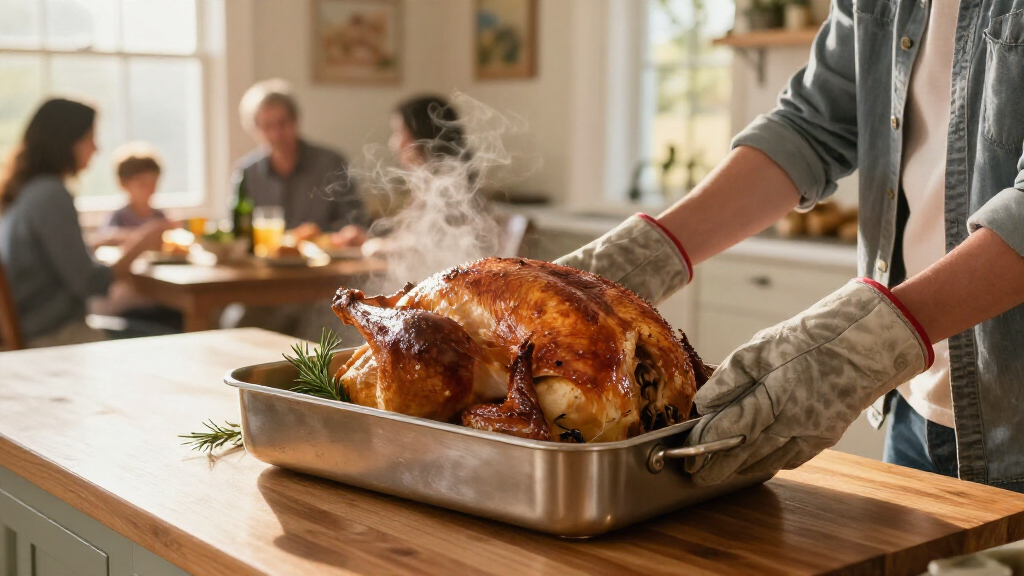
Think through the lift before Thanksgiving day. A large turkey in a heavy pan is an awkward load, and hot juices can slosh when the pan tilts. Clear the route to the counter before opening the oven. If two people are available, have one guide the pan and watch for obstacles while the other keeps a steady grip. Don’t rely on the thin edge of a foil pan as a handle; it can flex under the weight and spill hot liquid.
Plan the lift before roasting: use secure handles, oven mitts that let you grip them, and a helper for a heavy bird.
A pan that feels manageable empty can surprise you when loaded. Give yourself room to hold it level from oven to counter, and consider the combined weight when deciding whether the pan is appropriate for your turkey.
Use these five checks to choose your roasting pan
Choose a pan by matching five things: oven fit, turkey clearance, construction, cooking plans, and storage. These checks help you sort through marketing language by tying each feature to a real task. For instance, a removable rack is handy if you roast vegetables often, but it cannot solve a pan that blocks the oven door or leaves no safe room to handle it.
- Measure the oven: Check rack space, door opening, and clearance between racks. Include the pan’s handles in your measurements because they may determine whether the door closes.
- Check the bird: Look for space around the turkey and enough depth to catch juices without crowding the oven. Compare the pan with the bird’s shape, not just its weight.
- Test the build: Favor secure handles and a base that feels sturdy, especially for a large roast. A stronger pan is easier to move with confidence and less likely to warp under heat.
- Match your cooking: Confirm stove compatibility if you’ll make gravy in the pan, and check the finish’s temperature and utensil rules. If the pan cannot go on your burner, plan to make gravy in a saucepan.
- Plan storage and care: Confirm the pan fits your cupboard and that its cleanup needs suit you. A large pan that is difficult to store or wash may be less useful than a simpler one you can reach and maintain easily.
Say you roast a 12-pound turkey once a year, make gravy on an induction stove, and have a narrow oven. A roomy pan that looks impressive may be a poor choice if it fails the door check or lacks induction-compatible construction. A slightly smaller stainless pan with a secure rack may be more useful if it still leaves clearance around the bird. The point is to assess the checks together: passing one, such as turkey capacity, does not compensate for failing another, such as oven fit.
Use manufacturer dimensions and current care instructions as your reference. Terms like “heavy duty” or “easy clean” don’t tell you whether a pan fits your kitchen, works on your stove, or can be lifted safely when full.
Know when a baking sheet or foil pan can do the job
You can roast a turkey without a dedicated roasting pan if your alternative is deep and sturdy enough to contain the juices. For a smaller bird, a rimmed baking sheet with a rack may work well. It has lower sides than many roasting pans, which can help expose more of the bird to heat but also leaves less room for liquid. A deep casserole dish can suit a compact roast, but its high sides may limit air circulation and brown the bird less evenly. The alternative should match both the size of the turkey and the way you plan to lift it.
A disposable foil pan is inexpensive and convenient, especially if you don’t have storage for a large reusable pan. Its weakness is rigidity: once loaded with a turkey, liquid, and vegetables, the sides and base can flex. Supporting it on a sturdy baking sheet distributes the weight and gives you a firm surface to grip. Put the empty foil pan on the sheet before filling it, and carry the rigid sheet rather than pinching the foil edges.
For example, if you’re cooking a small turkey breast for two, a rimmed sheet pan with a rack may be all you need; its lower sides make it easy to handle, though you should check that it can contain the expected juices. If you’re roasting a whole bird for a large gathering, a flimsy foil pan is more stressful to move, particularly with hot drippings inside. A supported foil pan can still work, but the support does not make an undersized or shallow pan suitable. In every case, confirm that the vessel is oven-safe and can hold the expected weight.
A substitute is useful when its limits match the meal. It may save cupboard space or an extra purchase, but poor containment can leave juices in the oven and an unstable load can make serving risky. Consider the bird’s size, the depth of the vessel, and how you will move it before choosing the cheaper or more convenient option.
Make cleanup and safe serving part of the plan
Follow the pan’s care instructions, and use a food thermometer to check the turkey. The material determines which cleaning methods are safe: abrasive pads can scratch some coatings and finishes, while an unsuitable cleaner may damage the surface. Let the pan cool enough to handle safely before cleaning, then soak it in warm, soapy water to loosen baked-on drippings. Soaking gives residue time to soften, so you can avoid scraping aggressively and shortening the life of the pan.
Cleanup is easier when you act before dark drippings turn into a stubborn crust. After transferring the turkey, pour off excess fat carefully if needed, then add warm water once the pan has cooled enough to handle safely. If the instructions allow stovetop use, stock can help loosen browned bits for gravy. Otherwise, transfer the drippings to a saucepan. Checking the pan’s stove guidance beforehand prevents a last-minute scramble and avoids placing a pan on a burner it is not designed to handle.
Doneness is a separate question from pan size or roast time. Follow current food-safety guidance and use a food thermometer; the turkey’s color and the minutes on a recipe clock can’t reliably confirm its center has reached a safe temperature. Checking the thickest parts helps you judge doneness directly, while avoiding unnecessary extra roasting that can dry out the breast. A suitable pan supports the roast, but it cannot substitute for temperature checks.
A roasting pan can pull its weight all year: use it for ham, beef, chicken, or a tray of root vegetables. That broader use can make a reusable pan worthwhile, but only if it fits your kitchen and you are comfortable storing and cleaning it. The most useful pan is the one that fits your cooking habits, not the one with the most impressive list of features.
Frequently Asked Questions
What size roasting pan do I need for a Thanksgiving turkey?
Choose a pan with space around the bird and check that it fits your oven, including the door opening and rack clearance. Use the maker’s capacity guidance as a starting point, since turkey shape varies.
Do I need a rack for roasting a turkey?
No. A rack lifts the turkey so heat can circulate underneath and juices can collect below, but a bed of sturdy vegetables can serve as support. A V-shaped rack cradles a bird; a flat rack can be more versatile.
Can I make gravy in my roasting pan?
Only use the pan on the stove if its manufacturer says it is stovetop-safe and compatible with your burner type. If it isn’t, transfer the drippings to a saucepan and make the gravy there.
Are disposable foil pans safe for roasting a turkey?
A foil pan can work, but it is less rigid than a reusable roasting pan. Set it on a sturdy baking sheet before filling it, and lift the sheet rather than carrying the full pan by its thin edges.
How do I clean baked-on drippings from a roasting pan?
Let the pan cool, then soak it in warm soapy water to loosen the drippings. Use a cleaner and tool suited to the pan’s material; abrasive pads can scratch some nonstick coatings and finishes.
How do I know when the turkey is done?
Use a food thermometer and follow current food-safety guidance. Appearance and cooking time alone cannot reliably tell you whether the thickest parts of the turkey have reached a safe temperature.
Conclusion
Measure your oven first, then choose the pan that fits your turkey, your hands, and your cooking plans. A secure grip and a little breathing room matter more on Thanksgiving than a long feature list. If you already own a suitable rimmed sheet pan, use it for a smaller bird; if not, choose a reusable pan you can handle and store comfortably.
On the day itself, the best pan is the one that brings the turkey out safely, with the drippings ready for gravy and the kitchen still calm enough to enjoy the meal.